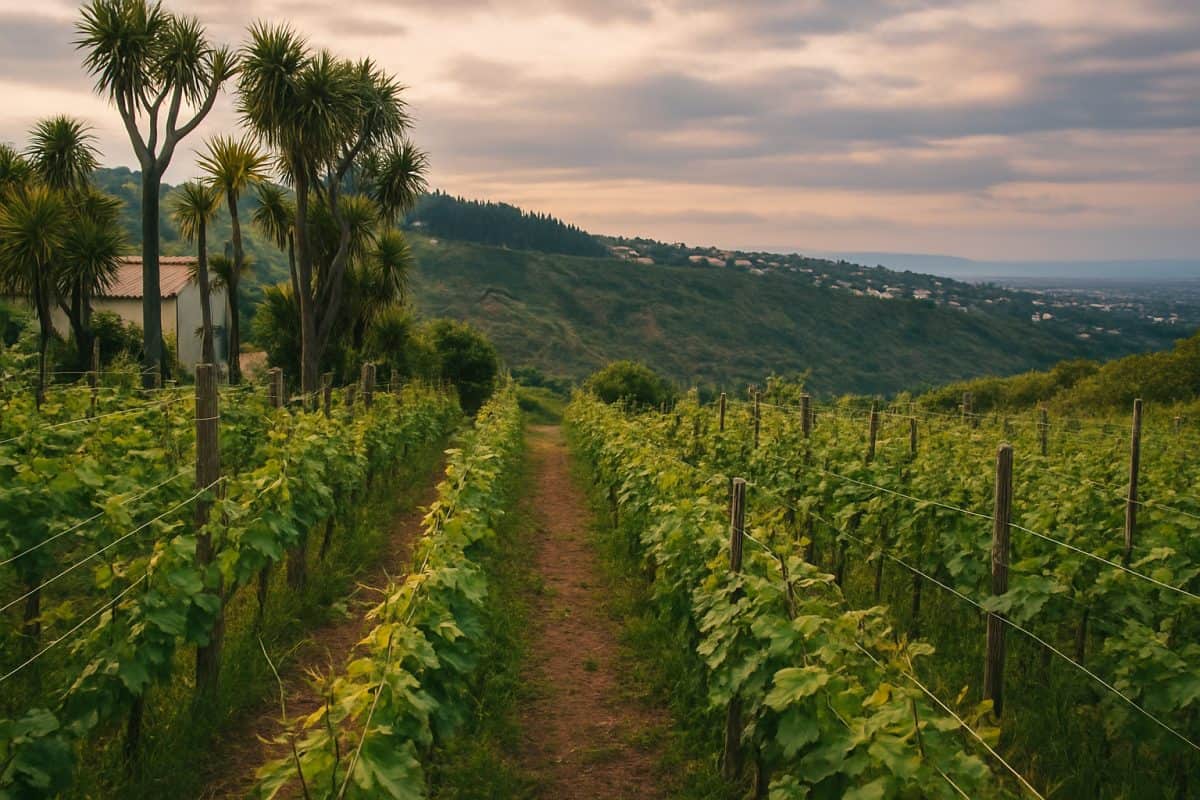
Most New Zealanders picture a wine trip as a proper expedition: a long drive, a gravel road, a whole day set aside. Tussock Hill quietly breaks that rule. It sits on the volcanic Port Hills about fifteen minutes from central Christchurch, a family-run organic vineyard with a cellar door restaurant and a balcony that looks clear across the city to the Southern Alps.

You can stand in central Christchurch, look south to the Port Hills, and know that somewhere up on that volcanic ridge there are vines. Tussock Hill sits at 210 Huntsbury Avenue in Cashmere, about a fifteen-minute drive from the central city. That is the whole pitch, and it is a good one: a working vineyard close enough to reach on a whim, far enough up the hill to feel like you have left the city behind.
The road up is narrow and a bit inconspicuous, the kind of climb where you start to wonder if you have the right address. Then it opens out, and you are looking at rows of vines on a slope with the city spread out below and the Southern Alps stacked along the horizon. It is a short trip that delivers a disproportionate amount of view.
Tussock Hill is family owned and family run, which is not marketing shorthand here so much as a literal description of who is doing the work. The Targett family bought the site a few years back, after Graham noticed the then-domestic vineyard was for sale while working as a carpenter on a nearby house. A seed was planted, as the better tellings of the story put it, and a half-formed idea turned into a proper vineyard and restaurant.
These days the operation runs on family labour from end to end. Graham and his sister Sally manage the viticulture, his parents John and Tina are involved, and Graham’s wife Melaina runs the cellar door. It was Melaina who decided early on that the wine needed food alongside it, which is why a visit now means lunch rather than just a tasting.

The thing that makes Tussock Hill worth understanding is that the fruit comes from two quite different places. There are the vines here on the volcanic Port Hills, planted across roughly ten acres on the slope above the city. And there is a separate block on the limestone soils of Waipara, the part of Canterbury most people think of first when they think of serious local wine.
That split matters. Limestone and volcanic rock are not the same canvas, and growing across both gives the winemaking something to work with rather than a single site to repeat. It is a more interesting starting point than a flat plant-and-pick vineyard, and it is the kind of detail that makes a cellar door visit better when you know to ask about it.
The wine here is organic and made with low-intervention practices, which the family describes in terms of respect for the fruit and the land rather than as a selling point. The idea is to let the grapes and the terroir do the talking, with the winemaking staying out of the way as much as it reasonably can. You can read more about the vineyard and its organic approach on the official Tussock Hill cellar door page.
This is the sort of place where the growing philosophy is not a bolt-on. The vines, the soils, and the choice to farm them organically are the whole point, and the food and the room are built around showing the wine off rather than the other way around.
Tussock Hill grows the kind of varieties Canterbury does well in its cooler corners, and the listings on the national directory describe it plainly as a boutique organic vineyard working across the Port Hills and Waipara. If you want the dry institutional version of who they are, the New Zealand Wine directory entry lays it out.
We will not put a number on any of it, because numbers are not how you understand a wine. What we will say is that the wines are made to be drunk with the food in front of you, here, on this hill. That is a different brief from making a bottle that has to survive a supermarket shelf, and it shows in how the pairings are built.
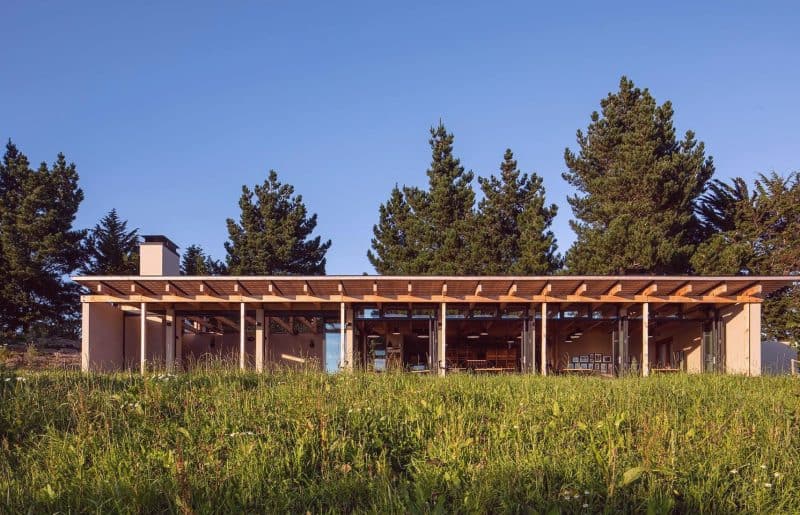
The cellar door restaurant runs a seasonal sharing menu, built by head chef Adam Harrison around the best local Canterbury produce and designed to pair with the organic wine. Sharing plates are the format, which suits the place: you order a spread, you pass things around the table, you slow down.
The menu changes with what is good rather than staying fixed, so any specific dish we named might be gone by the time you visit. The point is the approach. This is food built to make the wine pairings sing, not a generic bistro menu with a vineyard attached.
What lifts the food above competent is how close the sourcing stays to the site. The kitchen leans hard on Canterbury producers, and some of the plate comes from the section you are sitting on. Foraged kawakawa leaves have wrapped an octopus terrine; fennel flowers picked from the garden have finished a dish.
That is the same instinct that drives the wine: grow it here, source it here, serve it here. When the herbs on your plate were growing a few metres from the table, the connection between the place and the meal stops being a slogan and becomes something you can taste.
Then there is the room, or rather the part of it that is outside. The balcony looks out over the vines, across the Christchurch cityscape, and out to the Southern Alps on a clear day. It is the kind of outlook that does a lot of the work before the food arrives.
Descriptions of the place tend to circle back to the same idea: a sun-drenched balcony, the vineyard below, the city beyond, a glass of the wine that was grown in the rows you are looking at. It is hard to oversell a view like that, so we will just note that it is the reason a lot of people make the drive, and leave it there.
Tussock Hill is open Wednesday to Sunday for lunch, and closed Monday and Tuesday. Opening hours have shifted around over time, so treat that as the shape of things rather than gospel and check current hours before visiting, especially if you are planning around a weekday.
Bookings are strongly recommended, particularly on weekends, when the room fills and a walk-in is a gamble. This is a lunchtime restaurant rather than an all-day cellar door, so build your day around the middle of it: arrive, settle in, and give the sharing menu the couple of hours it deserves.
Getting there is genuinely easy by Canterbury standards. From the central city it is around a fifteen-minute drive up to Cashmere and onto Huntsbury Avenue, and the airport is a touch further out. There is parking on site, though it can fill on a busy weekend, with more available nearby.
The drive itself is part of the appeal. You climb out of the suburbs, the road narrows, and the view widens with every switchback until you are up among the vines. For a region where good wineries often mean a proper expedition, having one this close to town is a small luxury worth using.
There is something faintly absurd about being able to see the Port Hills from a city street and know there is a working organic vineyard up there, lunch waiting, the Alps lined up behind it. Tussock Hill makes a wine outing as easy as a quick drive up the hill, which rather undercuts the idea that good Canterbury wine has to be earned with distance.
Sophie Renwick
Wine Adventure
4 Comments
Did the drive up last Sunday on the strength of this. You’re not wrong about the road, I genuinely thought I’d taken a wrong turn before it opened out. The balcony view across to the Alps is something else.
Worth stressing the bookings advice. We rocked up on a Saturday without one a while back and the room was full. Rang ahead the second time and had no trouble. The sharing plates are the way to go.
Good to see someone make the point about the two soils. Most write-ups just say organic and leave it there. The Waipara limestone block versus the Port Hills volcanic stuff is the interesting bit.
Fifteen minutes from town for a proper vineyard lunch is hard to beat. Parking was tight when we went but there was plenty just down the road like you said.