Canterbury wine does not begin and end in Waipara. That valley deserves its reputation, but the region has other pockets where grapes grow — on the open plains west of Christchurch, in the clay-limestone foothills above the main valleys, and on the volcanic slopes of Banks Peninsula. Each has its own soils, its own microclimate, and its own reasons for existing. None of them are trying to be Waipara, which is exactly why they are worth paying attention to. This is a map of the places most Canterbury wine guides skip over, written for the kind of person who prefers the back road.
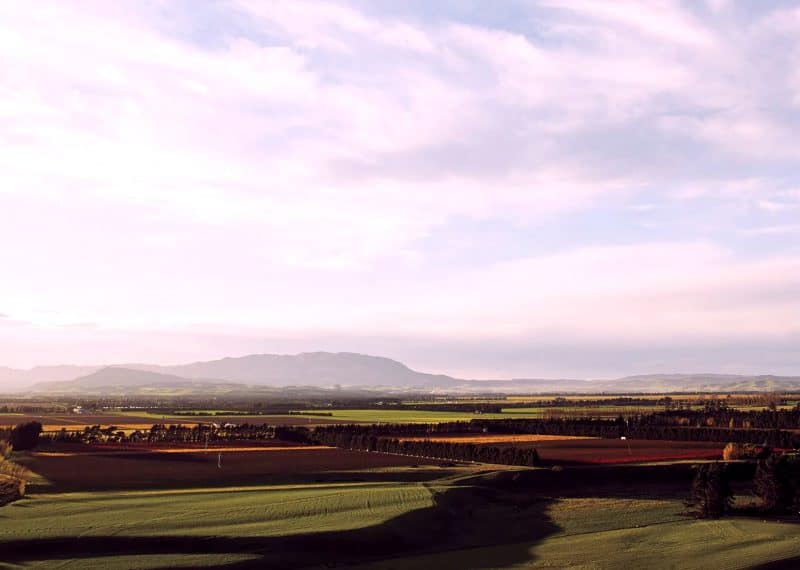
Canterbury is one of the few wine regions in New Zealand where a single wind pattern can make or break a vintage. The nor’wester — a foehn wind that tumbles down from the Southern Alps, compressing and heating as it drops — arrives on the plains like an uninvited guest with strong opinions. On a good day, it strips moisture from the canopy and pushes sugar levels along nicely. On a bad day, it scorches fruit and leaves vine rows looking like they’ve been through a convection oven.
The effect is amplified on the flat. There’s no topographic shelter out here, no fold in the land to buffer the blast. Growers on the Canterbury Plains have learned to read the nor’wester the way coastal fishermen read the tide — it’s not optional knowledge. The upside is the diurnal temperature range it helps create. Daytime heat followed by cool, still nights means grapes can ripen fully while keeping their acidity intact.
What you get in the glass is something leaner and more nervy than you might expect from a region that clocks serious sunshine hours. That interplay between warmth and wind is the signature of plains-grown Canterbury wine, whether the winemaker acknowledges it on the label or not.
If you drive west out of Christchurch on the old West Coast road, the suburbs give way to lifestyle blocks and then, occasionally, to rows of vines. West Melton sits on deep alluvial gravels deposited by ancient braided rivers — free-draining, low-fertility soils that force vine roots to work for their living. It is, by any measure, an unlikely place to grow wine, and yet people keep doing it.
Langdale Wine Estate has been the most visible producer on the western fringe, turning out pinot noir and pinot gris from gravel-dominated soils that would not look out of place in the Medoc. Further south, small hobby plantings dot the landscape around Tai Tapu and Lincoln, most of them too small to register commercially but interesting enough to suggest the land has something to say.
The Christchurch fringe is not a wine region in any formal sense. There is no appellation, no collective marketing body, no cellar door trail map. But the wines that come off these sites have a mineral directness that is hard to fake. The gravels impose discipline on the vine, and that discipline shows up as restraint and precision in the finished wine.
Strip away the hills and the shelter and you are left with a question: what actually thrives out here? The honest answer is aromatic whites. Pinot gris does particularly well on the plains, developing that faintly honeyed weight without losing its line. Riesling, too, finds the continental climate sympathetic — the long, dry autumns let growers hang fruit late, chasing flavour development without the rot pressure that plagues wetter regions.
Chardonnay can work, though it tends toward a leaner, more citrus-driven style than its Hawke’s Bay cousins. Think green apple and wet stone rather than peach and toast. Some growers have tried gewurztraminer with mixed results — the lychee aromatics emerge beautifully in warm years, but the variety’s thin skin makes it vulnerable when the nor’wester turns nasty.
Pinot noir is the outlier. It grows on the plains, technically, but most winemakers will admit off the record that the best Canterbury pinot comes from sites with some elevation or shelter. Out on the flat, the variety can struggle to develop the mid-palate generosity that makes it compelling. The exceptions exist, but they tend to prove the rule: plains pinot is a lighter, more transparent style, and you either appreciate that or you reach for something from Waipara instead.
Waipara gets all the attention. That is fair enough — it earned it. But above the main valley floor, where the land tilts upward toward the Teviotdale hills, there are limestone outcrops and clay-rich slopes that produce something quite different from the warm, sheltered valley below. These higher sites sit at 200 to 350 metres, enough altitude to shave a degree or two off ripening temperatures and add a week or more to the growing season.
The limestone here is not the soft, chalky stuff you find in Champagne. It is harder, more fractured, shot through with calcium carbonate that roots chase downward through fissures in the rock. Wines from these soils tend to have a saline, almost flinty quality that is harder to find on the gravel flats below. A handful of producers — some operating under their own labels, others selling fruit to larger Waipara operations — have been quietly working these upper slopes for over a decade.
The irony is that these sites are technically within the Waipara wine region, but the wines they produce taste more like a different postcode. Higher acid, tighter fruit, longer ageing trajectories. If you have ever tasted a Canterbury pinot noir that made you stop and reconsider what the region can do, there is a reasonable chance it came from up here.
Oxford is one of those Canterbury towns that feels further from Christchurch than the actual distance suggests. Tucked against the base of the foothills, with the Waimakariri River gorge cutting through the ranges to the north, it occupies a climatic niche that is cooler and slightly wetter than the open plains. The soils here shift from river gravels to heavier clay-loam with limestone fragments — a mix that retains moisture through dry summers and gives wines a rounder, more textured feel.
There is not much planted here yet, and that is putting it generously. A few small-scale growers have put in experimental blocks of pinot noir and chardonnay, drawn by the altitude and the soil profile. The results so far are promising in the way that early-stage wine regions always are: full of potential, short on data, and requiring a certain optimism to interpret.
What Oxford does have going for it is aspect. The north-facing slopes above the township get good sun exposure but stay cool enough to extend hang time significantly. The gorge channels a breeze that keeps disease pressure low without the aggression of the plains nor’wester. It is the kind of site that makes viticulturists lean forward in their chairs when you describe it, even if the commercial reality is still a decade or more away.
The arithmetic of foothill viticulture is simple: for roughly every 100 metres you climb, the average temperature drops by about 0.6 degrees Celsius according to standard lapse rate calculations. That does not sound like much until you realise it can add two to three weeks to the ripening window. More hang time means slower sugar accumulation, which means grapes reach flavour maturity without racing ahead on alcohol. The result, when it works, is wine with lower alcohol and higher natural acidity — a combination the market is increasingly interested in.
Canterbury’s foothills offer this in abundance. The slow-ripening advantage produces pinot noir with fine, persistent tannins rather than the plush, forward fruit you get from warmer valley floors. Riesling from altitude tends toward a steelier, more austere style, the kind that rewards patience and a few years in the cellar. Even chardonnay takes on a more restrained character, with citrus and mineral notes dominating over the stone fruit and oak that warmer sites encourage.
The trade-off is risk. Slower ripening means a longer exposure to autumn weather, and in Canterbury, autumn can turn from golden to brutal in a matter of days. Frost is a genuine concern at altitude, and yields tend to be lower, which makes the economics harder to justify. But for growers willing to accept those terms, the foothill wines of Canterbury are quietly some of the most compelling in the country.
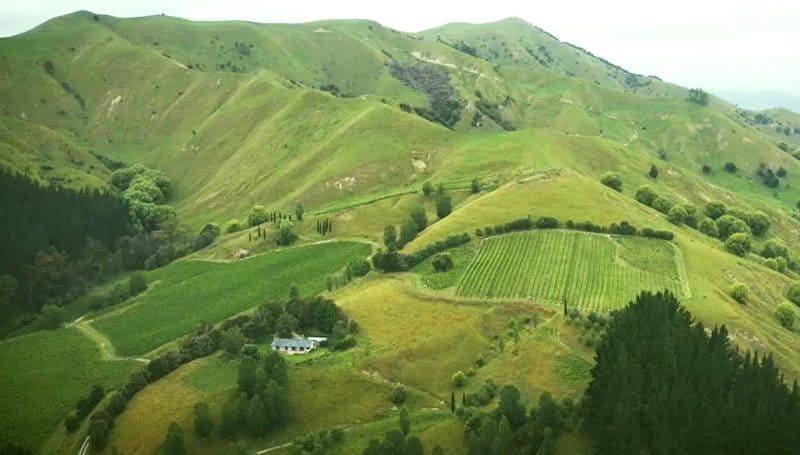
Banks Peninsula is an old volcanic complex, and the soils show it. Basalt-derived clay loams, dark and mineral-rich, sit in pockets between the eroded ridgelines that radiate from the summit of the ancient caldera. These are heavier soils than anything on the Canterbury Plains — they hold water, they hold heat, and they give wines a density and earthiness that feels almost Mediterranean in character.
The maritime influence is the other half of the equation. Surrounded by the Pacific on three sides, the peninsula experiences more moderate temperature swings than inland Canterbury. Winters are milder, summers are cooler, and there is a persistent onshore breeze that keeps humidity in check without the violence of the nor’wester. For grapevines, this means a gentler growing season, slower and more even ripening, and lower frost risk than you might expect at this latitude.
Together, the volcanic soil and the ocean air create conditions that have no real equivalent elsewhere in New Zealand. The closest comparison might be Waiheke Island, though the peninsula is cooler and the soils are different. Whether this combination can support a viable wine industry is still an open question, but the raw materials — the terroir, if you want to use the word — are genuinely interesting.
French Farm Bay sits on the northern shore of Akaroa Harbour, a sheltered inlet where the water reflects light and heat back onto the steep, north-facing slopes above. It is, arguably, the warmest microclimate on the entire peninsula, and someone had the good sense to plant vines here. The results have been modest in scale but intriguing in character — pinot noir with an earthy, almost savoury quality that you rarely encounter in Canterbury.
Further around the harbour, a handful of other growers have established small blocks on the volcanic slopes. Most of these are passion projects rather than commercial operations. The land is steep, access is difficult, and the scale is too small for anything approaching efficiency. But the wines, when you can find them, have a distinctiveness that comes from growing grapes in a place that is not trying to be anywhere else.
Canterbury has a long connection with French settlers at Akaroa, and there is a pleasing symmetry in the idea of French Farm Bay becoming a wine-producing site. The peninsula’s viticulture is still closer to experiment than industry, but the harbour vineyards represent the most convincing evidence that Banks Peninsula fruit can make serious, distinctive wine. You just have to be willing to look past the postcard scenery to notice it.
Let us be honest about this. Banks Peninsula is a beautiful place to grow grapes, and beautiful places have a way of attracting wine projects that are driven more by romance than by rigour. The volcanic soils are genuinely distinctive, and the maritime climate is appealing on paper. But the peninsula also has steep terrain, limited flat land, high development costs, and a tourist economy that pushes land values beyond what a vineyard operation can reasonably justify.
The argument for the peninsula as a real wine region rests on terroir. If you believe that the combination of basalt soils, ocean influence, and sheltered harbour microclimates can produce wines that taste like nowhere else — and there is some evidence that they can — then the impracticalities are just obstacles, not disqualifications. Burgundy is not exactly convenient either.
The argument against is economic and logistical. Scale matters in wine, and the peninsula may never support enough vineyards to build a recognisable identity. Individual producers can make excellent wine from peninsula fruit, but without critical mass, there is no appellation, no marketing clout, no reason for a casual wine buyer to seek it out. The peninsula might always be a footnote — but then again, footnotes are often where the most interesting reading happens.
For all their differences in soil and elevation, Canterbury’s wine-growing pockets share a single climatic engine: a continental pattern defined by high sunshine hours, low annual rainfall, and a diurnal temperature range that would make a Burgundian jealous. Christchurch averages over 2,100 sunshine hours per year and receives less than 650 millimetres of rain — drier than Marlborough, sunnier than most of the North Island.
That continental thread gives Canterbury wine its family resemblance. Whether the fruit comes from plains gravel, foothill clay, or peninsula basalt, there is a structural clarity that runs through the finished wines like a watermark. Acidity tends to be bright and natural rather than forced. Flavours lean toward citrus, mineral, and herb rather than tropical or confected. Alcohol levels sit, on average, a notch below their equivalents from warmer parts of the country.
This is what separates Canterbury from its more famous neighbours. Marlborough has its own continental character but adds river valley fertility and the amplifying effect of the Wairau Plain. Central Otago pushes the continental dial further toward extreme, with higher altitude and colder winters. Canterbury sits in between — warm enough to ripen a wide range of varieties, cool enough to keep them honest. It is not the loudest wine region in New Zealand, but it might be the most internally diverse.
Part of the problem is branding, or the lack of it. When someone says Canterbury wine, the immediate association is Waipara. And when someone says New Zealand wine, the immediate association is Marlborough sauvignon blanc. Canterbury’s other pockets — the plains, the foothills, the peninsula — have no collective name, no shared identity, and no voice in the national conversation. They exist in the gaps between more established narratives.
There is also the earthquake factor, which is rarely mentioned in wine writing but matters more than people think. The 2010 and 2011 earthquakes disrupted Canterbury’s hospitality infrastructure, redirected tourism patterns, and consumed the attention and capital of a generation of local business owners. Some vineyards were damaged. Others lost their cellar door traffic as visitors stopped coming to a region associated with disaster. The recovery has been steady but slow, and the wine industry has been rebuilding alongside everything else.
The tide is turning, though. A new generation of growers and winemakers are planting in Canterbury with fresh eyes, drawn by the climate data and the relative affordability of land compared to Marlborough or Central Otago. They are less interested in competing with Waipara than in defining something new. Whether that effort coalesces into a recognisable regional identity remains to be seen, but the quality of the wine coming out of these pockets suggests it should.
The best way to explore Canterbury’s sub-regions is to abandon any pretence of efficiency. This is not Marlborough, where you can hit six cellar doors before lunch. Out here, the vineyards are scattered, the cellar doors are few, and some of the most interesting producers sell only by the case from their kitchen table. You need a car, a willingness to get slightly lost, and the kind of patience that wine itself is supposed to teach you.
Start on the plains if you are based in Christchurch. West Melton is a twenty-minute drive, and the contrast between city fringe and vineyard is jarring in the best way. Head north toward Oxford for the foothills, then loop east to pick up the Waipara Valley on your way to the coast. Banks Peninsula is its own day trip — take the Summit Road for the views, drop down into Akaroa, and ask around. Someone will know who is making wine.
The point is not to tick off a list of producers. Canterbury’s wine geography is still being written, and the pleasure of exploring it lies in the discovery rather than the destination. You will find excellent wine in unexpected places, mediocre wine in beautiful ones, and occasionally a bottle that makes you rethink everything you assumed about what this part of the country can do. That is worth the drive.
Canterbury’s wine geography is more varied and more interesting than its reputation suggests. The plains, the foothills, and the peninsula each bring something different to the glass — different soils, different exposures, different expressions of a shared continental climate. Not all of these pockets will become recognised wine regions in any official sense. Some may remain footnotes, curiosities, experiments. But the best wines coming out of these overlooked corners have a quality that the more established regions should take seriously: they taste like somewhere specific. In a wine world that increasingly rewards distinctiveness, that counts for more than you might think.
Sophie Renwick
Wine Adventure
Leave a comment