
The Canterbury Plains are not where you would plant a vineyard if you had any choice in the matter. Flat, wind-hammered, frost-prone, and dependent on irrigation for every drop of water — it is a landscape that seems designed to discourage viticulture. And yet a small cluster of growers near West Melton and across the wider plains have done exactly that, producing wines that taste unmistakably of their difficult origins. This is their story, told without romantic embellishment.
Stand on the Canterbury Plains west of Christchurch and you understand immediately why most winemakers looked elsewhere. The nor’wester arrives without warning — a hot, dry wind that funnels through the Southern Alps and hits the flat land with nothing to slow it down. No hills, no valleys, no convenient shelter belts. Just open paddock stretching to the horizon.
Spring frosts are the other regular visitor. Cold air pools on flat ground in ways it simply cannot in a valley with decent drainage. A September morning that drops to minus three can strip an entire season of potential fruit in a few hours. Growers on the plains talk about frost as a near-certainty rather than a risk.
The combination is genuinely punishing. Vines need shelter from wind to set fruit properly, and they need frost protection to survive spring. On the Canterbury Plains, you get neither for free. Every solution — shelter belts, frost fans, overhead sprinklers — costs money and takes years to establish. The land itself is indifferent to your ambitions.
The west Melton wine growing area sits on old river gravels — the kind of free-draining, stony ground that vines actually prefer. Water passes through quickly, forcing roots deep into the substrate where they find traces of mineral content that more fertile soils would mask. It is not generous country, and that turns out to matter.
Canterbury’s continental climate delivers genuine heat in summer, as documented by Lincoln University’s Centre for Viticulture and Oenology, often matching or exceeding Marlborough’s growing degree days. The difference is that Canterbury’s heat comes with enormous diurnal range — scorching afternoons followed by cool nights that can drop fifteen degrees in a few hours. This preserves acidity in the fruit, which is why Canterbury whites at their best have a brightness that warmer regions struggle to achieve.
The long, dry autumns help too. While Marlborough growers watch the March rain forecasts with dread, Canterbury often stays dry well into April. Grapes hang longer, developing flavour without the rot pressure that humidity brings. It is a narrow advantage, but a real one, and it is the reason a handful of people looked at this flat, windswept ground and saw potential rather than paddock.
Nothing grows on the Canterbury Plains without irrigation. Annual rainfall sits around 600 millimetres — roughly half what a vineyard needs during the growing season. Every drop that reaches the roots has been pumped, allocated, metered, and paid for.
Water allocation in Canterbury is a fraught subject. The region’s aquifers have been under pressure for decades, and the tension between agricultural users, environmental flows, and urban supply is not going away. Vineyard operators hold consent to draw water, but those consents come with conditions, limits, and the ever-present possibility of restriction during dry years.
Some growers have moved toward deficit irrigation — deliberately stressing the vines by giving them less water than they would ideally like. The theory is that mild stress concentrates flavour in the fruit. The practice is a nerve-wracking balance between concentration and vine death.
Get it right and you produce intensely flavoured grapes from tiny yields. Get it wrong and you have dead wood. It is a strange thing, building a wine industry on land where the most fundamental ingredient has to be negotiated for.
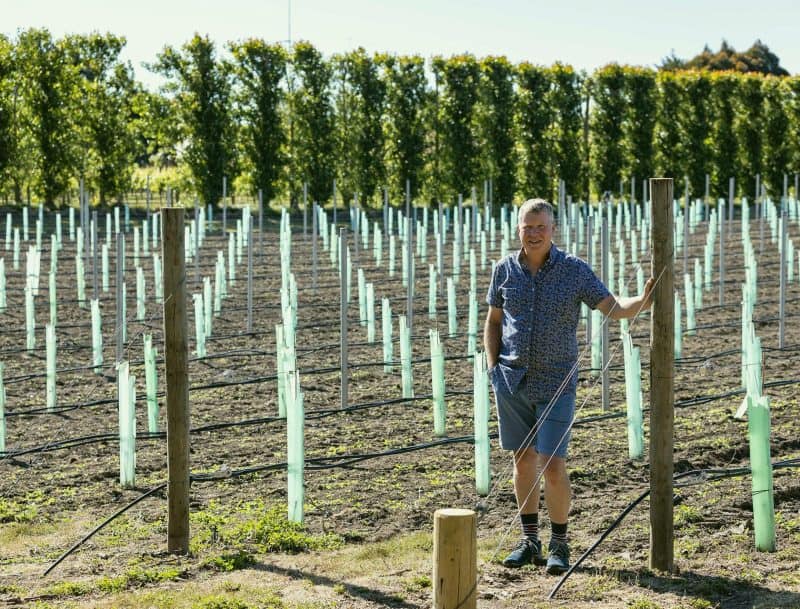
The vineyards scattered across the Canterbury Plains are small by any standard. A few hectares here, a couple more there — blocks tucked behind shelter belts on properties that often run sheep or grow crops on the rest of the land. These are not estates. They are experiments that stuck.
The people behind them tend to share a certain profile. Many came to viticulture from other careers — engineering, teaching, farming — and brought with them a willingness to learn by doing that more formally trained winemakers might find alarming. They planted because they were curious, not because a business plan told them to.
What keeps them going is harder to pin down. It is partly the satisfaction of producing something genuinely distinctive in a place that was not supposed to produce it at all. Partly the camaraderie of a tiny community where everyone knows everyone’s vintage and nobody pretends the work is easy.
And partly, if you push them on it after a glass or two, the quiet conviction that their wines are worth making even if the world has not noticed yet.
Waipara Valley sits barely an hour north of the Canterbury Plains vineyards, and it would be easy to assume the two regions are interchangeable. They are not. Waipara has limestone-influenced soils, north-facing slopes, and the Teviotdale hills blocking the worst of the coastal weather. The plains have none of these things.
Plains growers visit Waipara, taste Waipara wines, and talk to Waipara winemakers. The knowledge transfer is real and valuable — clonal selection, canopy management, harvest timing. But the smart ones understand that copying Waipara’s approach on flat gravel country would be foolish. Different soil, different exposure, different microclimate. Different wine.
The distinction matters because it shapes what plains growers aim for. Rather than chasing the richness and weight that Waipara’s best Pinot Noirs achieve, the better plains producers lean into their own conditions — making wines that are lighter, more aromatic, sometimes sharper. It is not a compromise. It is an acknowledgement that the land gives you what it gives you, and the winemaker’s job is to listen rather than argue.
The numbers are not kind. Yields on the Canterbury Plains run low — wind damage during flowering, frost losses in spring, and the natural restraint of stony, irrigated soils all conspire to keep tonnage down. A productive Marlborough vineyard might pull ten tonnes per hectare. A plains vineyard doing well might manage four.
Labour costs are the same as anywhere else. Equipment costs are the same. But the revenue from four tonnes is considerably less than the revenue from ten, and no amount of romantic storytelling about terroir changes that arithmetic.
Then there is the market. Canterbury wine has modest recognition. Canterbury Plains wine has almost none. Telling a customer at a farmers’ market that your Pinot Gris comes from West Melton usually generates a blank look followed by polite interest. You are selling the story from scratch every single time.
These vineyards survive because their owners have other income, low overheads, or a philosophical acceptance that wine is not where the money comes from. It is a model that works for individuals but will never build an industry.

If the Canterbury Plains are going to be known for anything, it will be aromatic whites. Pinot Gris and Riesling both perform genuinely well here — the enormous diurnal temperature range preserves the natural acidity that these varieties need, while the stony soils add a mineral undercurrent that richer country cannot replicate.
The Pinot Gris from plains vineyards tends toward the leaner, Alsatian end of the spectrum rather than the soft, slightly sweet style that dominates New Zealand supermarket shelves. Pear and white stone fruit sit over a chalky, almost saline finish. These are wines that want food beside them rather than a sunny deck.
Riesling is arguably even more suited to the conditions. The variety thrives on stress, rewards patience, and produces wines of startling clarity when the growing season cooperates. Plains Riesling at its best has lime zest, wet stone, and an acidity that could cut glass — austere in youth but capable of developing genuine complexity with a few years in bottle.
Gewurztraminer makes occasional appearances too, its lychee and rose petal character tempered by the cool nights into something more restrained than the variety usually manages in New Zealand.
Pinot Noir on the Canterbury Plains is a gamble, and the results reflect it. In warm vintages with a long, settled autumn, the variety can produce something genuinely compelling — pale, fragrant, with red cherry and dried herb notes that recall Burgundy’s lighter communes. These wines exist. They are rare.
More commonly, plains Pinot Noir struggles to reach full phenolic ripeness. The wines can taste lean and green, with tannins that feel skeletal rather than fine. This is not a criticism of the winemakers — it is simply what happens when you grow a heat-demanding variety in a marginal climate on exposed ground. Some years the climate cooperates. Many years it does not.
The honest growers will tell you this. They will pour you their Pinot Noir with a slight shrug and say something like “this is what 2024 gave us.” The less honest ones will reach for words like “elegant” and “restrained” when “underripe” would be more accurate.
There is a growing argument that the plains might be better served by abandoning Pinot Noir entirely and focusing resources on the whites that clearly belong here. It is a reasonable argument. Nobody seems ready to act on it.
Terroir is a word that gets thrown around carelessly in wine marketing, but it means something specific: the idea that a wine can taste of where it comes from. The Canterbury Plains have terroir. It is just not the kind that sells easily.
Plains wines tend to be lean, bright, and sometimes austere. They have an angular quality — all edges and mineral brightness rather than the generous fruit weight that most New Zealand wine drinkers expect. Put a Canterbury Plains Riesling next to a Marlborough Sauvignon Blanc and many people will choose the Sauvignon. It is louder, more immediate, more obviously appealing.
But spend time with the plains wines and something shifts. That austerity starts to read as precision. The mineral quality that seemed cold at first becomes compelling. You start to notice how well these wines work with food — how a lean Pinot Gris can make a piece of salmon sing in a way that a richer wine would smother.
Unfashionable places produce unfashionable wines, and that is not always a bad thing. Fashion changes. The land does not. The handful of growers making wine on the Canterbury Plains are banking on the idea that what their ground produces has value — not because it competes with Marlborough or Central Otago, but because it tastes like nowhere else.
The Canterbury Plains will never rival Waipara, let alone Marlborough or Central Otago. The growers here know this, and the good ones have stopped trying. What they are doing instead is more interesting — making wines that could only come from this particular stretch of stony, windswept ground, and trusting that the character of the place is worth bottling. Whether the market ever catches up is an open question. Whether the wines deserve attention is not.
Sophie Renwick
Wine Adventure
Leave a comment