
Drive north out of Waipara, past the last familiar cellar doors, and keep going. About 133 kilometres from Christchurch, in a sheltered basin north of Cheviot, sits the vineyard that grows Mt. Beautiful. It is the northern frontier of Canterbury wine, and very nearly the only significant producer brave enough to plant this far up the coast.
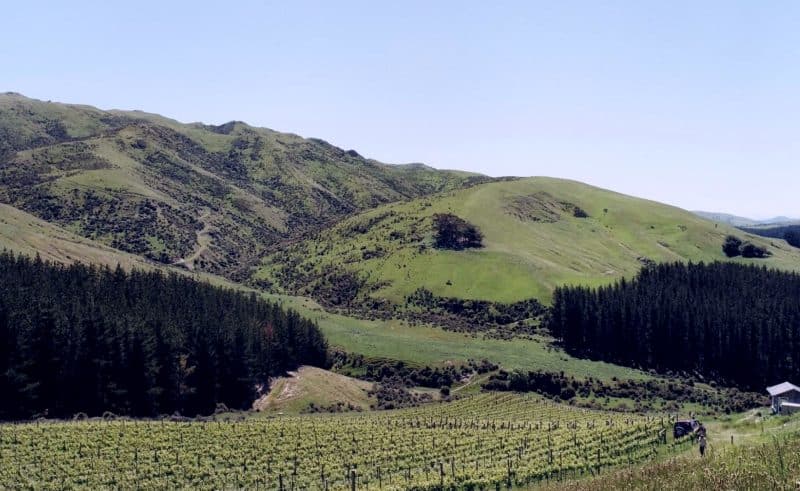
Most people who drink Mt. Beautiful have never been near the place it comes from, and that is half the point. The grapes are grown and the wine produced at Spotswood, a rural basin roughly nine kilometres north of Cheviot township in North Canterbury. Cheviot itself sits about 133 kilometres up the coast from Christchurch, which makes Spotswood the better part of two hours from the city.
That distance matters. Drive north out of Waipara and the cellar doors thin out fast, then stop. Keep going past Cheviot and you are into Kaikoura country, where nobody is growing wine grapes. Spotswood is the last vineyard before the map runs out.
The site is not flat. The vines are planted on a series of terraced tablelands that step up from the valley floor, and the whole arrangement sits in what the growers describe as a naturally protected bowl, sheltered by the coastal range to the east and the Kaikoura Seaward Mountains to the north.
Running through the middle is a deep gully the locals call the Chasm. It does real work. On still winter nights, cold air drains down the channel and away from the vines rather than pooling around them, which is how a vineyard this exposed manages its frost risk. The terraces are angled to catch the sun, and the soils underneath are gravelly and free-draining. None of it is decorative. It is the reason grapes ripen here at all.
It is worth being plain about how unusual the location is. North Canterbury’s wine reputation is built on Waipara, with a scattering of growers through the Waikari and Omihi hills. Cheviot is well beyond all of that. As far as significant producers go, Mt. Beautiful is effectively on its own up here, the northern frontier of Canterbury wine.
The brand leans into the remoteness, and even borrows a line from critics who call North Canterbury the country’s most underestimated wine region. You can take or leave the framing, but the geography is real enough. The little township of Cheviot, sitting between the Hurunui and Waiau rivers, is not where you would expect to find a vineyard at all, which is exactly why this one is interesting. The wider district has a long pastoral history, and the history of Cheviot itself is a farming story far more than a wine one.

Leigh and David Teece founded Mt. Beautiful in 2004, and the decision that defines the whole project was made before a single vine went in: they chose Cheviot Hills rather than one of North Canterbury’s proven patches further south. David is a Cantabrian by birth who built an academic career in the United States; Leigh is a Californian. Bringing the family story back to his home country was the stated reason for planting here at all.
They could have bought into Waipara, where the soils and the reputation were already established. Instead they backed a district nobody had tested, on the theory that it shared the qualities of New Zealand’s admired growing regions without the crowd. It was a bet, and an expensive one, on a place that had never grown wine grapes commercially.
What they bought was farmland, and like much of the South Island east coast it had a long pastoral tradition behind it. The transition from pasture to vines was done slowly, which is the only sensible way to do it.
The planting was eventually divided into twenty-three separate blocks, each one mapped to its own sun exposure, aspect and soil. That sounds like a lot of fuss for a single farm, but it is how you make sense of a site with this much variation in slope and drainage. The estate trades under Teece Family Vineyards and Farms, which is a useful reminder that this is still a working farm as much as a winery, with the vineyard nestled into the landscape rather than imposed on it.
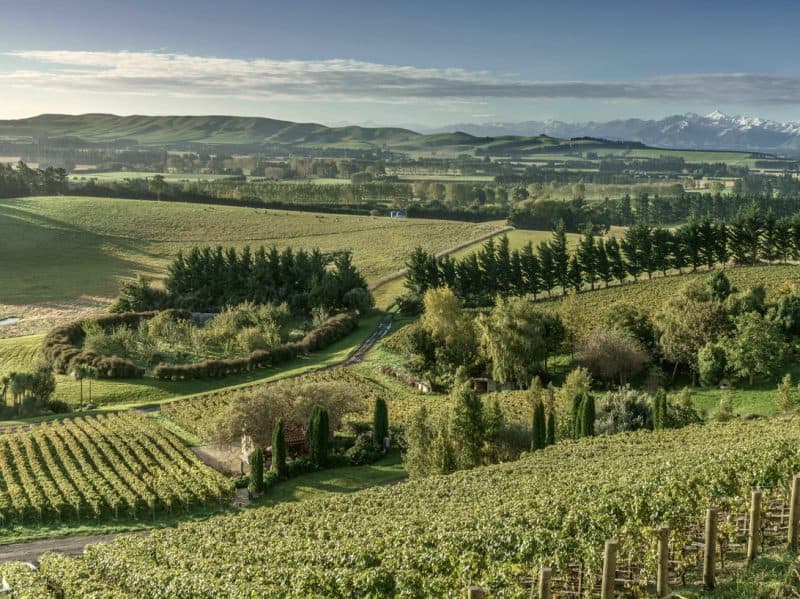
The whites are where the cool, exposed site shows its hand. The Sauvignon Blanc is the one most people meet first, and the producer describes it reaching across the herbaceous range into tropical fruit rather than sitting in the sharp green register Marlborough made famous.
The Riesling is built around mandarin and citrus, the sort of variety that genuinely rewards a long cool autumn, which Cheviot has in spades. The Chardonnay leans on ripe apple and stone fruit with a flinty, mineral finish. Read across the three and a pattern shows up: fruit that ripens properly, but kept in check by the latitude. Whether that lands for you is a tasting-room question, not a back-label one.
On the red side it is Pinot Noir, which is no surprise for a cool Canterbury site with good diurnal swing and free-draining soils. Pinot is the variety that tells you most about where it was grown, so it is the obvious one to reach for if you want to taste the place rather than the brand.
Pinot Gris rounds out the core range, with a Rose appearing in the line-up as well. It is a tight portfolio by design, five or six estate-grown wines rather than a sprawling list, which is what you would expect from a single estate that grows everything it bottles.
If there is a thread running through the whole range, it is restraint. The winery talks about a more reserved approach, about harmony and balance, and explicitly positions the style as different from most New Zealand wine by virtue of both location and intent.
That is marketing language, so treat it as a hypothesis rather than a verdict. But it points at something real: a far-north Canterbury site with a long cool ripening season is going to make wine with a different shape to the riper, louder styles further north. The honest position is that you cannot settle it from a website. You settle it with a glass in your hand, which is the whole reason the cellar door exists.
The tasting happens not at the vineyard but in Cheviot township, at the Mt. Beautiful Two Rivers Cafe and Wine Tasting Room on Hall Street. It is a renovated space, light and airy, that keeps elements of its original structure and pulls in macrocarpa and oak milled from trees on the estate. A long concrete counter runs north to south with a deliberate gap in the middle, a nod to the Chasm that splits the vineyard.
Here is the important caveat: the room’s status is genuinely unclear from the outside. One of the winery’s own pages lists it as temporarily closed, while other listings show midweek hours. Sources do not agree, and we are not going to pretend they do. Check the current hours and status directly with the cellar door before you make the trip, because a closed door at the end of a two-hour drive is a miserable way to spend an afternoon.
Plan it as a proper expedition, not a casual detour. From Christchurch you are looking at roughly 112 kilometres and about ninety minutes; from Kaikoura it is closer, around an hour; from Hanmer Springs allow ninety minutes across country. The full range and tasting details are laid out on the official Mt. Beautiful site, which is the place to confirm anything before you leave.
The sensible way to do Cheviot is to fold it into a bigger run rather than treat it as the sole destination. Heading up to Kaikoura for the day, or coming back south from the whales, puts you within easy reach. Either way, ring ahead. This is the one cellar door in Canterbury where turning up on spec is a genuine gamble, and the remoteness that makes the place worth visiting is the same thing that makes it worth a phone call first.
There is a particular satisfaction in wine that comes from the edge of where it can be grown. Mt. Beautiful is not the most convenient cellar door in Canterbury, and it does not pretend to be. What it offers is the chance to taste a place that almost nobody else has bothered to plant, which is its own quiet kind of reward.
Sophie Renwick
Wine Adventure
4 Comments
The bit about the Chasm draining cold air off the terraces is the detail I never knew. Makes sense of how they get anything ripe that far north.
We made the run up from Christchurch last summer thinking it’d be a quick stop and ended up turning it into a whole Kaikoura day like you suggest. Glad we did, because it really is a fair drive past Waipara. The Riesling was the one that stuck with me.
Agree about tasting the Pinot Noir if you want the place rather than the brand. We did the counter tasting and the Pinot was a different animal to the Marlborough stuff we usually drink. Worth the gravel.
Good call on ringing ahead. We rocked up on a Monday a while back and the cellar door was shut, so the warning about checking hours first is spot on.