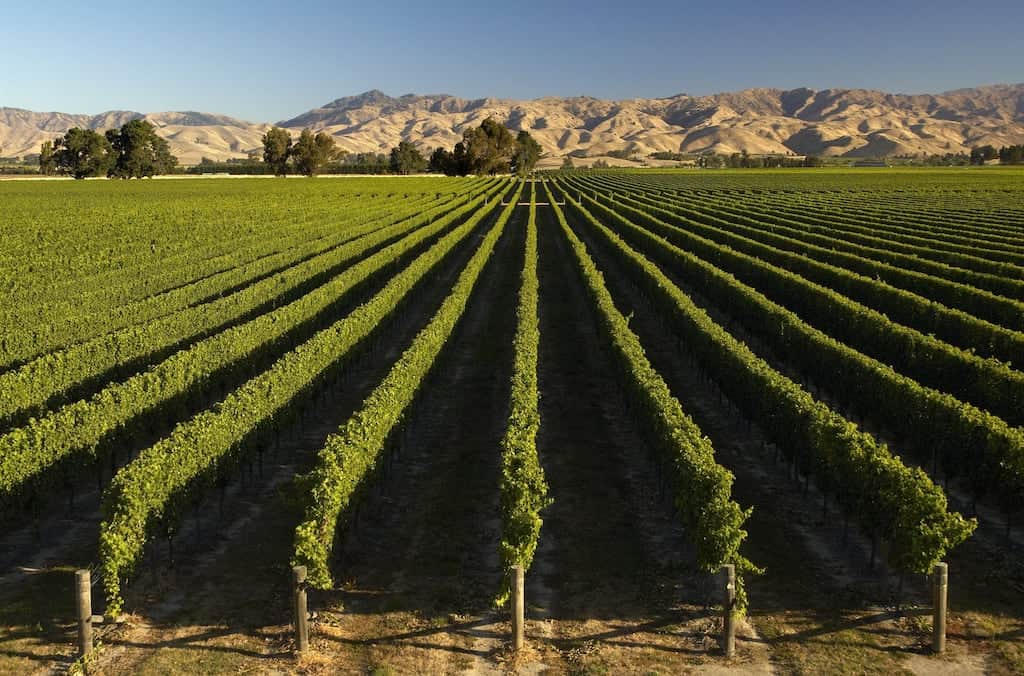
Canterbury Pinot Noir does not announce itself the way Central Otago does. There is no immediate rush of dark fruit and sweet oak, no obvious power play. What it does instead is more interesting and harder to fake — it asks you to pay attention. The cool-climate conditions of the Waipara Valley, the limestone soils, the long ripening season that stretches into autumn, all of this produces a Pinot Noir with a particular kind of restraint that takes a glass or two to fully appreciate. This is wine shaped by place rather than ambition, and once you understand what Canterbury is doing differently, it changes how you taste everything else.
Canterbury sits at roughly 43 degrees south, which puts it in the same latitude band as Burgundy — a comparison the local producers are careful not to overstate, though the parallel is real enough when you look at the numbers. The diurnal range here, the gap between daytime highs and overnight lows, regularly hits 15 to 18 degrees Celsius during the ripening months. In practical terms, a Waipara afternoon in February might reach 30 degrees, then drop to 12 by midnight.
That swing is what gives Canterbury Pinot Noir its particular character. Warm days build flavour compounds and sugar. Cool nights preserve the natural acidity that keeps the wine taut and lifted rather than soft and jammy. The ripening season stretches longer than in warmer regions — harvest often runs into late April here, sometimes early May in cooler vintages. Grapes hang on the vine for weeks longer than they would in Hawke’s Bay, accumulating complexity without racing toward overripeness.
The result is fruit that arrives at the winery with genuine concentration but also a brightness that warmer climates struggle to retain. You taste it as a kind of energy in the finished wine, a sense that the fruit has not been hurried.
Nobody farms Pinot Noir in Canterbury because it is easy. Spring frosts are a genuine hazard, particularly on the valley floor where cold air pools in the early hours. Most Waipara growers have lost at least one crop to a bad frost event, and the 2019 spring caught several producers off guard with a late October freeze that damaged emerging shoots across multiple vineyards.
Wind is the other constant. The nor’wester comes through the valley with real force — hot, dry, and capable of shredding canopies if the vines are not managed for it. Growers train their vines low and use windbreaks, but the wind also does useful work: it keeps the canopy dry, reducing disease pressure and cutting the need for sprays. Several organic and biodynamic producers in the valley credit the wind as a key reason their approach works here.
The economics are honest. Yields in Canterbury Pinot Noir tend to sit between 3 and 6 tonnes per hectare, well below the national average. Frost, wind, and the naturally low vigour of limestone soils all contribute. You cannot farm Canterbury for volume, which is partly why the wines cost what they do — and partly why the producers who choose this region are a self-selecting group of people who would rather make interesting wine than profitable wine.
Canterbury’s climate is technically continental by New Zealand wine region standards, or as close to continental as New Zealand gets. The Southern Alps block the moisture-laden westerlies, creating a rain shadow that keeps annual rainfall low — Waipara averages around 650mm, roughly half of what Marlborough receives. That dryness, combined with the temperature extremes, creates growing conditions that stress the vines just enough to produce concentrated, structured fruit.
The acidity profile of Canterbury Pinot Noir is its calling card. Where Central Otago Pinot tends toward generous fruit sweetness balanced by alcohol, and Marlborough Pinot leans on bright, sometimes sharp acidity, Canterbury sits in a different place entirely. The acidity here is firm but integrated — it reads as structure rather than tartness, more like the backbone of the wine than a flavour in its own right.
Tannin development follows a similar pattern. The long, cool ripening season allows phenolic compounds to mature fully without the sugar levels racing ahead. Canterbury Pinot Noir at harvest often shows lower brix than equivalent Central Otago fruit but more complex tannin structure. The wines tend to finish drier, with a savoury quality that emerges in the mid-palate rather than announcing itself on the first sip.
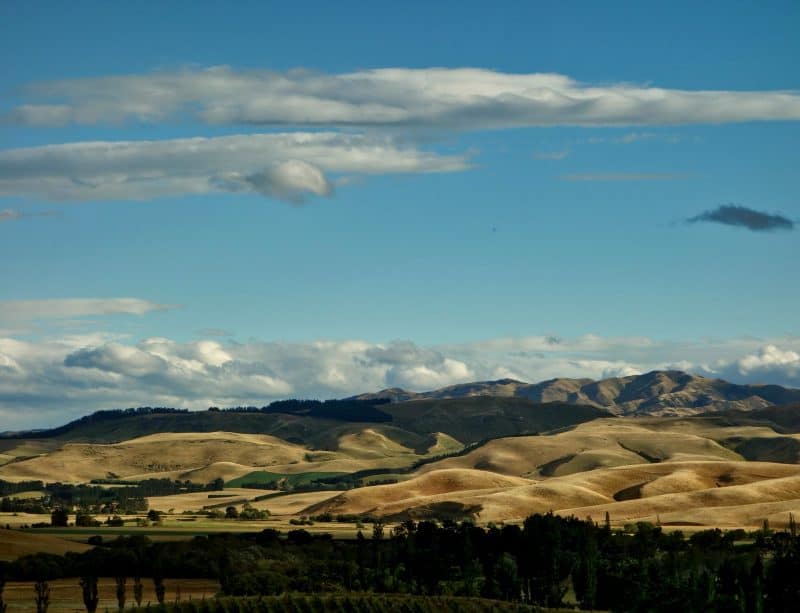
The limestone that runs through the Waipara Valley is not a marketing story. It is a geological fact that shapes every serious Pinot Noir produced in the region. The belt of Tertiary limestone extends along the western side of the valley, exposed on the hillsides where erosion has cut through the overlying clays and loess. At Black Estate’s Omihi vineyard, you can pick up chunks of fossilised shell from between the vine rows. At Bell Hill, the limestone is so close to the surface that planting required pneumatic drills.
This is sedimentary limestone — ancient seabed compressed over millions of years — and it does two things that matter for Pinot Noir. First, it provides exceptional drainage. Water moves through limestone freely, which means vine roots must push deep to find moisture during the dry Canterbury summers. Deep roots access a more stable water supply and a wider range of mineral nutrients. Second, limestone is alkaline, which in Canterbury’s context moderates the naturally acidic subsoils and creates a pH environment that encourages steady, even ripening.
Burgundy’s greatest vineyards sit on limestone. So does the best land in Waipara. The comparison is geological, not aspirational — but it is not a coincidence either.
Not all of North Canterbury is limestone. The valley floor and the eastern terraces are dominated by greywacke gravels and clay — river-deposited soils that behave quite differently from the hillside limestone. These are heavier soils, with greater water-holding capacity and more fertility. Vines planted here grow with more vigour, producing larger canopies and potentially higher yields.
The Pinot Noir from clay and greywacke sites tends to be rounder and more fruit-forward than its limestone counterpart. Pegasus Bay, which farms alluvial terraces near the valley mouth, produces a Pinot Noir that emphasises dark cherry and plum fruit with a supple, generous texture. It is recognisably Canterbury — the acidity and restraint are there — but the soil signature is different. Less mineral tension, more fleshy generosity.
Several producers farm across both soil types. Greystone, for instance, has plantings on limestone slopes and clay flats, and the difference shows clearly in barrel tastings before blending. The limestone parcels bring structure and minerality. The clay parcels bring fruit weight and mid-palate richness. The final wine is a conversation between two soil types, and the balance shifts slightly with each vintage.
Whether soil minerals actually transfer to wine in any measurable chemical sense is a debate that wine scientists and winemakers will never resolve over a single dinner. What is less debatable is that site matters in Canterbury, and that the differences between vineyard blocks planted on different soils show up consistently in the glass.
Limestone-grown Canterbury Pinot Noir has a particular textural signature: a fine, chalky grip on the finish that sits underneath the fruit like a layer of fine sandpaper. It is not aggressive — you would not call it tannic in the way you might describe a young Barossa Shiraz — but it gives the wine a dry, persistent finish that keeps drawing you back for another sip. Winemakers here call it mineral, and whether that term survives scientific scrutiny hardly matters when the sensation is so consistent from site to site.
Clay-grown fruit speaks differently. The wines tend to be fleshier through the middle, with softer tannins and a finish that resolves more quickly. They are often more approachable young, which makes them useful in blends and appealing to drinkers who find limestone Pinot a bit austere on release. Both styles are genuine expressions of Canterbury — just different chapters of the same geological story.
Black Estate has become something like Canterbury’s flagship Pinot Noir producer, though Nicholas Brown would probably wince at that description. The estate farms organically on the Omihi hillside, a steep, north-facing slope of limestone and clay that sits above the valley floor with views across to the Teviotdale hills. The site is exposed, windswept, and difficult to farm — exactly the kind of marginal land that produces exceptional Pinot Noir when everything goes right.
Their Home Vineyard Pinot Noir, from the original Omihi plantings, is the wine that converted many Christchurch drinkers to Canterbury Pinot. The 2020 vintage showed the style at its most precise: red cherry, dried herbs, a thread of smoky complexity, and that characteristic limestone finish — chalky and long. It is not a big wine. It does not try to impress you with concentration or oak. It earns your attention through detail and persistence.
The Damsteep bottling, from a single steep block, pushes the intensity further while keeping the same essential restraint. If you visit the cellar door — and you should, the restaurant is one of the best vineyard dining experiences in the South Island — ask to taste the two side by side. The terroir lesson takes about three minutes and zero jargon.
Greystone sits on the same limestone ridge as Black Estate but further north, where the soils are slightly deeper and the aspect shifts. Dom Maxwell has built a reputation at Greystone for wines that combine power with precision — the Pinot Noir has more fruit weight than some of its neighbours but never loses the structural discipline that marks it as Canterbury. The 2019 vintage was a strong example: dark cherry and boysenberry fruit, firm but ripe tannins, and a finish that kept unfolding for minutes after you swallowed. It is the kind of wine that rewards patience, both in the glass and in the cellar.
Bell Hill is a different proposition entirely. Marcel Giesen and Sherwyn Veldhuizen planted their vineyard in 1997 on a steep limestone hillside that most people would have dismissed as unfarmable. Yields are tiny — often under 2 tonnes per hectare — and the wines are made in genuinely small quantities. Bell Hill Pinot Noir is among the most Burgundian wines made in New Zealand, not because it imitates Burgundy but because it shares that quality of seeming transparent to its site. The 2018 showed wild strawberry, iron, dried flowers, and a savoury undertow that lingered well into the next conversation. If you can find a bottle, it is worth whatever they are asking.
Pegasus Bay operates at a different scale and from a different philosophy, but the wines deserve their reputation. The Donaldson family has farmed this site since the 1980s, and their Pinot Noir — particularly the Prima Donna reserve — shows what Canterbury clay and greywacke can do when managed by people who understand the land intimately. The style is richer and more generous than the limestone producers, with dark fruit, spice, and a velvety texture that makes it approachable young while still rewarding cellaring.
Mountford Estate, tucked into the hills above Waipara township, farms biodynamically on a mix of limestone and clay. Their Pinot Noir has a wild, slightly untamed quality — herbs, undergrowth, dark cherry — that reflects both the farming philosophy and the sheltered hillside site. Production is small and the wines can be hard to find outside Canterbury, which is a shame because they represent a genuinely distinctive voice in the region.
Between these producers and the dozen or so smaller operations scattered through the valley, Canterbury has enough diversity to keep a curious drinker occupied for years. Each vineyard tells a slightly different version of the same story: what happens when you plant Pinot Noir on challenging ground in a cool climate and give it time to speak.
Cool-climate restraint is one of those wine terms that gets thrown around without much explanation. In Canterbury Pinot Noir, it means something specific and recognisable once you know what to look for. Pour a glass of good Canterbury Pinot beside a Central Otago equivalent and the difference is immediate — not better or worse, but genuinely different in kind.
Canterbury Pinot tends toward red fruit rather than dark. Cherry, raspberry, and cranberry dominate, often with herbal or floral notes layered through — dried thyme, lavender, sometimes a hint of dried rose petal. The fruit is precise rather than lush. Where a warm-climate Pinot might fill your mouth with sweet, ripe berry flavour, Canterbury Pinot places its flavours carefully, leaving space between them.
The texture is lighter, too. Not thin — good Canterbury Pinot has real concentration — but the weight sits differently in the mouth. There is a transparency to the best examples that lets you taste through the fruit to the structure beneath. It is the difference between a wine that impresses you and a wine that interests you. Both have their place, but Canterbury has chosen its side.
Central Otago Pinot Noir has earned its international reputation honestly. The combination of extreme altitude, intense UV light, and schist soils produces wines of remarkable concentration and power. A top Central Otago Pinot from Bannockburn or Calvert is a genuinely thrilling wine — dark-fruited, muscular, with a sweet-spice richness that fills the glass.
Canterbury does not compete on those terms, and the better producers have stopped trying. The comparison is more useful as a contrast: where Central Otago pushes toward power, Canterbury pulls toward tension and detail. Central Otago Pinot is often at its best on a winter evening with braised lamb. Canterbury Pinot is the wine you reach for when you want something that sharpens your attention rather than relaxes it — alongside a duck breast, perhaps, or aged hard cheese.
Marlborough Pinot Noir sits somewhere between the two, though the best Southern Valleys examples have developed their own identity in recent years. Marlborough tends to emphasise bright, sometimes piercing acidity with red fruit and a leaner frame. Canterbury shares the acidity but wraps it in more texture and complexity, particularly from limestone sites. If Marlborough Pinot is a watercolour, Canterbury Pinot is a pencil drawing — all line and detail and precise shading.
This is where Canterbury Pinot Noir asks for your patience and rewards it. The combination of firm acidity, ripe tannins, and relatively moderate alcohol creates a wine with genuine cellaring potential — something that not all New Zealand Pinot Noir can claim. The limestone-grown examples, in particular, seem to gain complexity over time rather than simply softening.
A 2015 Black Estate Home Vineyard, tasted in 2024, had developed a savoury complexity — mushroom, leather, dried herbs — while retaining the red fruit core and chalky finish of its youth. It had not become a different wine; it had become a deeper version of itself. Similarly, older vintages of Bell Hill show an evolution toward earthy, truffle-like complexity that recalls aged Burgundy without imitating it.
The practical advice is straightforward. Entry-level Canterbury Pinot Noir drinks well young and does not need cellaring. Single-vineyard and reserve bottlings from serious producers — Black Estate Damsteep, Greystone, Bell Hill, Pegasus Bay Prima Donna — benefit from three to eight years in a cool, dark place. Beyond that, you are in territory where the wine may surprise you, but you are also taking a chance. Canterbury’s track record with long-aged Pinot is still being written, one patient bottle at a time.
Canterbury Pinot Noir is not trying to be the next Central Otago, and it is better for it. The region has found its own voice — quieter, more detailed, built on acidity and mineral texture rather than fruit power and generosity. The best bottles from Waipara reward the kind of drinker who is willing to sit with a wine, to notice how it changes in the glass, to appreciate structure as much as flavour. If you have been drinking New Zealand Pinot Noir without visiting Canterbury, you have been reading the book with a chapter missing. The drive from Christchurch takes forty minutes. The understanding takes longer, but that is the point.
Sophie Renwick
Wine Adventure
Leave a comment