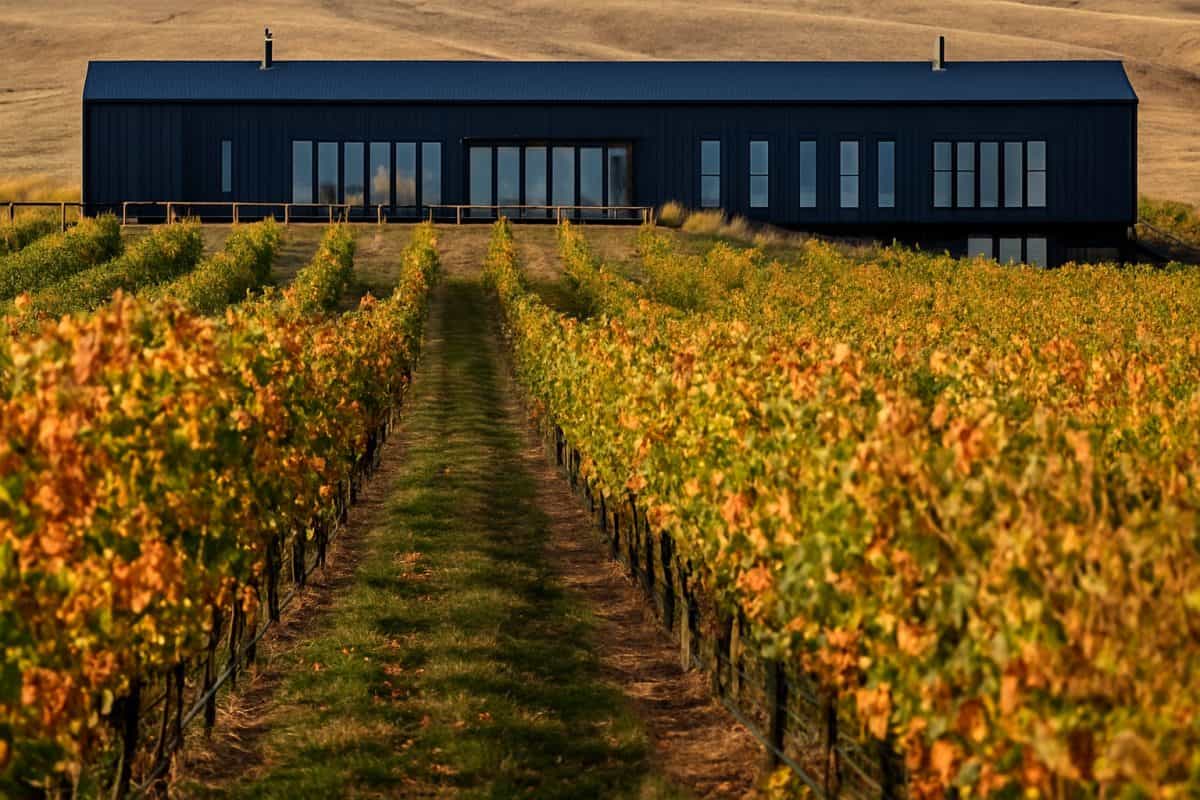
Black Estate sits on a limestone ridge above the Waipara Valley, and it is one of those places that rewards repeat visits. The cellar door, the restaurant, the biodynamic vineyard — each one deserves your time, but together they make a case for North Canterbury wine country that is hard to argue with. This is what I have learned from going back across three seasons.

You turn off State Highway 1 just north of Amberley and the landscape shifts within minutes. The flat Canterbury farmland gives way to dry, folded hills streaked with pale limestone outcrops. Omihi Road climbs gently through tussock and scrub, past a few lifestyle blocks and the odd stand of old macrocarpa. There is no signage overload, no wine trail branding — just the road and the hills and, if you have the windows down, the smell of warm clay and dried grass.
The first time I drove it, I nearly missed the turn. The second time, in late autumn, the whole hillside was copper and gold and I pulled over just to look at it. By the third visit I had stopped noticing the drive as separate from the destination. That is probably the point.
Black Estate sits at the top of this road in the Waipara wine district like it grew out of the ground, which in a sense it did. The building materials came from nearby. The vines were planted into this specific slope for specific reasons. Nothing about the arrival feels accidental.
The cellar door building is rammed earth and timber with floor-to-ceiling glass on the valley side. It looks like an architectural award entry, because it is one. But it does not feel like a showpiece when you walk in. The concrete floor is stained with wine. The tasting counter is heavy native timber, worn smooth. There are no velvet ropes or hostess stands.
On a quiet Tuesday in winter you might be the only person there, standing at the counter while someone pours you a glass of pinot gris and talks about the frost that hit the chardonnay block in October. On a Saturday in February you will be sharing the space with twenty other people and the energy is completely different — louder, warmer, slightly chaotic in that good way.
The staff know the wines because they work the vineyard. Ask about the fermentation and you get a real answer, not a rehearsed one. That is the thing about Black Estate — it is not performing authenticity. The place just is what it is.
Everyone talks about the terrace, and they should. You step outside with your glass and the whole Waipara Valley opens up below you — vines in the foreground, then a patchwork of farmland, then the Teviotdale hills fading into blue distance. On a still day the only sound is wind in the grass and the occasional bird.
In summer the light is hard and bright and everything looks bleached. Autumn softens it — the rows of pinot noir turn red and orange, the hills go tawny. I sat out there one June afternoon in a nor’wester with a glass of the Home Chardonnay and watched clouds building over the ranges. The wine was cold, the wind was warm, and nobody was in a hurry to go anywhere.
That is what the terrace does. It makes you slow down. You came for a quick tasting and suddenly it is two hours later and you are on your second glass and you have learned more about Waipara soil types than you ever expected to care about.
Black Estate pinot noir is not trying to be Burgundy and it is not trying to be Central Otago. It tastes like Waipara limestone — there is a chalky, mineral thread running through every vintage that anchors the fruit. The 2022 Home Pinot Noir had dark cherry and dried herbs on the nose, but the finish was all about texture. Fine-grained tannins, a savoury pull, and that distinctive cool-climate acidity that makes you want another sip before you have finished thinking about the last one.
The 2021 was different again. More generous, slightly fleshier, with a note of dried rose petal that kept appearing. Winemakers Nicholas and Pen Naish farm three distinct vineyard sites across the Waipara hills, and the variation between vintages is part of the appeal. These are not wines made to a formula. The Centre for Viticulture and Oenology at Lincoln University has documented how Canterbury’s limestone soils produce pinot noir with distinct mineral qualities.
If you have only had Waipara pinot from the big producers, the Black Estate style might catch you off guard. It is leaner, more restrained, less interested in impressing you upfront. Give it twenty minutes in the glass and it opens into something genuinely complex.
I used to think Canterbury chardonnay was thin. Sharp and lean and not particularly interesting. Then someone poured me the Black Estate Home Chardonnay 2021 and I had to reconsider everything.
It was whole-bunch pressed and wild fermented in old French oak — no new barrels, no heavy-handed winemaking. The result was a wine with the weight and texture of something from a warmer climate but the acidity and freshness of Waipara. Stone fruit and citrus peel on the nose. A faint smoky quality from the oak that never dominated. And a finish that went on and on, minerally and dry, like licking a clean limestone pebble. I realise that sounds odd. It was a compliment.
The 2022 leaned more towards white flowers and green apple. Still that beautiful mid-palate density. Still that length. Each vintage is a snapshot of a specific season in a specific set of hills, and that is exactly what good chardonnay should be.
The pinot and chardonnay get all the attention, but the tasting room usually has three or four other wines open that reward curiosity. The Rose is not an afterthought — it is made from pinot noir with real intention, dry and savoury with a pale salmon colour and flavours closer to wild strawberry than anything sweet.
Their pet-nat, when they have it, is a genuine natural sparkling made by the ancestral method. Cloudy, slightly funky, bone dry, and the kind of wine that divides a room. I love it. My partner thinks it tastes like cider that gave up halfway through. Both of us are correct.
There is also the occasional field blend or experimental bottling that only appears at the cellar door. These are small-batch wines, sometimes just a barrel or two, and they sell out fast. If the person behind the counter offers you something you have not heard of, say yes. The whole point of visiting a cellar door is tasting what you cannot get at the bottle shop.
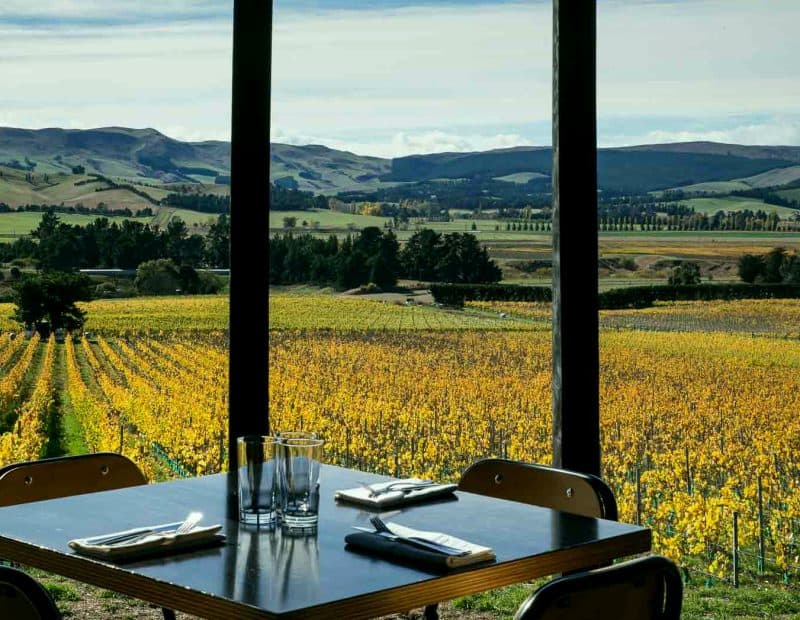
The restaurant at Black Estate is not a restaurant in the usual sense. There is no fixed menu that runs for months. What you eat depends on what is growing in the kitchen garden, what the local suppliers have, and what the chef felt like doing that morning.
On one visit in late summer the menu featured a salad of roasted beetroot and goat’s curd from a farm down the road, with walnuts and a dressing made from their own verjuice. Simple, sharp, perfect with the rose. A winter lunch months later opened with a pumpkin soup that tasted like autumn distilled — sweet, earthy, finished with brown butter and sage.
The portions are considered rather than generous. This is not a place to come starving and expect a mountain of food. It is a place to come hungry and curious and willing to eat whatever they put in front of you. The bread is always excellent. The vegetables taste like they were pulled from the ground that morning, which sometimes they were.
You can choose your own wine, obviously. But there is something to be said for asking the staff what they would pour with your meal. They know the current releases at a level of detail that borders on obsessive, and they know the menu because they eat it.
A lamb dish with cumin and preserved lemon arrived one afternoon and the suggestion was the Home Pinot Noir 2021 — the slightly fleshier vintage, with enough fruit weight to stand up to the spice. It worked. The wine softened around the meat and the acidity cut through the fat.
On a different visit, a delicate ceviche of local fish came paired with the pinot gris, which had just enough residual sweetness to balance the lime. The pairings are never showy. Nobody is going to deconstruct flavour compounds at your table. But the matches are thoughtful, and eating here with the right wine in your glass turns a good lunch into something you remember for months.
Biodynamic farming has a reputation problem. Mention it and half the room thinks you are talking about moon planting and burying cow horns, which is not entirely wrong but misses the larger picture. At Black Estate, biodynamic certification means the vineyard is farmed as a self-sustaining system. No synthetic herbicides or pesticides. Compost preparations made on site. Planting and harvesting timed to natural cycles.
The cow horn thing is real, by the way. Preparation 500 involves packing cow manure into a horn and burying it over winter, then spraying the resulting concentrate across the vineyard in spring. It sounds odd. Nicholas Naish will tell you with a straight face that it works, and then show you the soil biology data to support the claim.
What matters on the ground is that the vineyard looks and feels different from a conventional operation. There are flowers between the rows. The soil is dark and crumbly and full of worms. The vines are not propped up by chemical inputs. They either thrive in this ground or they do not, and the ones that remain are deeply rooted and self-sufficient.
If you ask, and sometimes even if you do not, someone will walk you through the vineyard. Take them up on it. The difference between reading about biodynamic farming and standing in the middle of it is the difference between looking at a menu and eating the food.
The first thing you notice is the ground cover. Between the vine rows there are grasses and clover and wildflowers — not weeds, but a deliberately maintained ecosystem that feeds the soil and attracts beneficial insects. Bend down and pick up a handful of earth. It smells alive, dark and damp and faintly sweet. Compare that to the bare, compacted dirt in a conventionally sprayed vineyard and the argument starts to make itself.
The vines are smaller than you might expect. Biodynamic yields are lower, which is part of the point. Less fruit per vine means more concentration in what remains. You can see the limestone chips in the topsoil, white fragments mixed through the dark earth, and it clicks — this is where that mineral character in the wine comes from. Not a metaphor. Actual rocks.
This is the question everyone eventually asks, and the honest answer is: probably, but not in the way you think. You are not going to taste biodynamics in a single glass. There is no flavour called “moon-planted” or “cow horn-enhanced.” But across a range of Black Estate wines, and especially when you compare them to conventionally farmed Waipara wines, there is a shared quality that is hard to name.
The wines feel alive in the mouth. There is a vitality and a sense of the wine evolving as you drink it. The textures are fine and layered. The finishes are long. Whether that comes from biodynamic farming or simply from low yields and careful winemaking on good soil is genuinely impossible to separate. The North Canterbury wine region is still young enough that the Naish family are among its pioneers, and after a few visits, their conviction is persuasive.
What I can say is that these wines taste like a specific place. They do not taste manufactured or formulaic. And that, more than any certification label, is what makes the drive up Omihi Road worthwhile.
Some cellar doors are worth a detour. Black Estate is worth rearranging your weekend. Bring someone you like, order the wine the staff suggest, and stay longer than you planned. The valley will still be there when you finally leave the terrace.
Sophie Renwick
Wine Adventure
Leave a comment